Is Bilingualism a Predictor of the Brain Age Gap in Older Adults?
Introduction
The brain age gap (BAG) compares estimated brain age with chronological age, where a more negative BAG indicates a younger-looking brain.
The following examples can be used to see this in practice:
- A BAG of −11 means the brain appears 11 years younger than its owner (e.g., estimated age 56, chronological age 67).
- A BAG of 0 means the brain looks exactly its age (e.g., estimated 67, chronological 67).
- A BAG of +2 means the brain appears 2 years older than its owner (e.g., estimated 69, chronological 67).
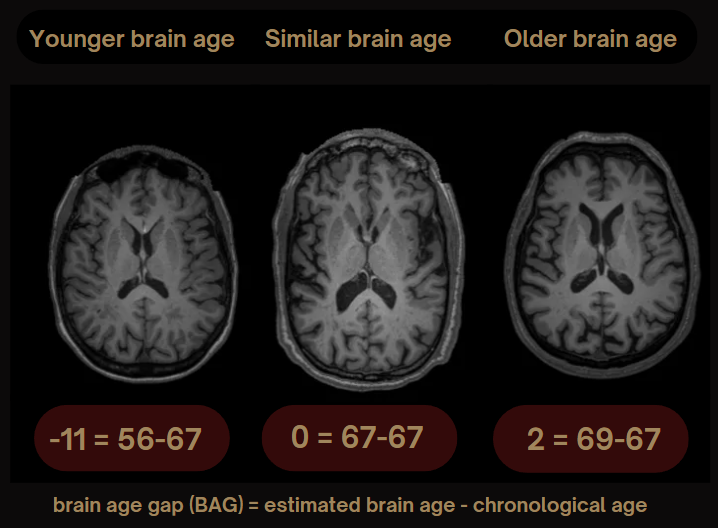
Because bilingualism is thought to promote brain resilience, potentially protecting against age-related neural changes;1 we tested whether bilingualism-related variables predict BAG in cognitively unimpaired older adults.
Aim & Methodology
Forty-four English-French cognitively unimpaired bilingual older adults completed an MRI scan and a language background questionnaire. Brain age was estimated from T1-weighted MRI data using brainageR.2 The model's performance was validated with a mean absolute error (MAE) of 8.13 years and a correlation of r = .61 (p < .001) between estimated and chronological brain age. MAE reflects the average prediction difference between estimated and chronological brain age.
We examined three bilingualism-related variables as predictors of BAG:
- L2 fluency — self-reported proficiency in the second language.
- L2 age of acquisition (AOA) — the age at which the participant began learning their second language.
-
Global language-usage entropy — a measure of overall language balance, computed using the Shannon entropy formula.3
H = −(pL1 log2 pL1 + pL2 log2 pL2)where pL1 and pL2 are the proportions of total conversations in each language. Scores range from 0 (all conversations in one language) to 1 (conversations evenly split between both languages). This is a global entropy score reflecting the overall distribution of language use, rather than entropy across different social contexts. Higher values indicate a more balanced overall bilingual language profile.
Results
Language entropy showed a significant positive correlation with BAG (r = 0.44, p = .003), whereas L2 fluency (r = 0.22, p = .150) and L2 age of acquisition (r = 0.02, p = .900) were not significantly associated with BAG.
Significant correlations are indicated by * at p < .05.
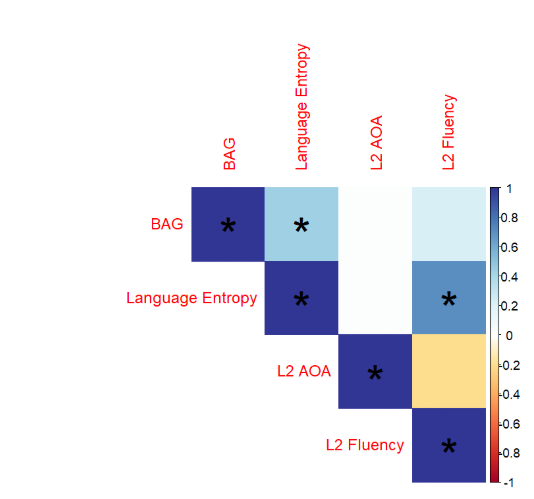
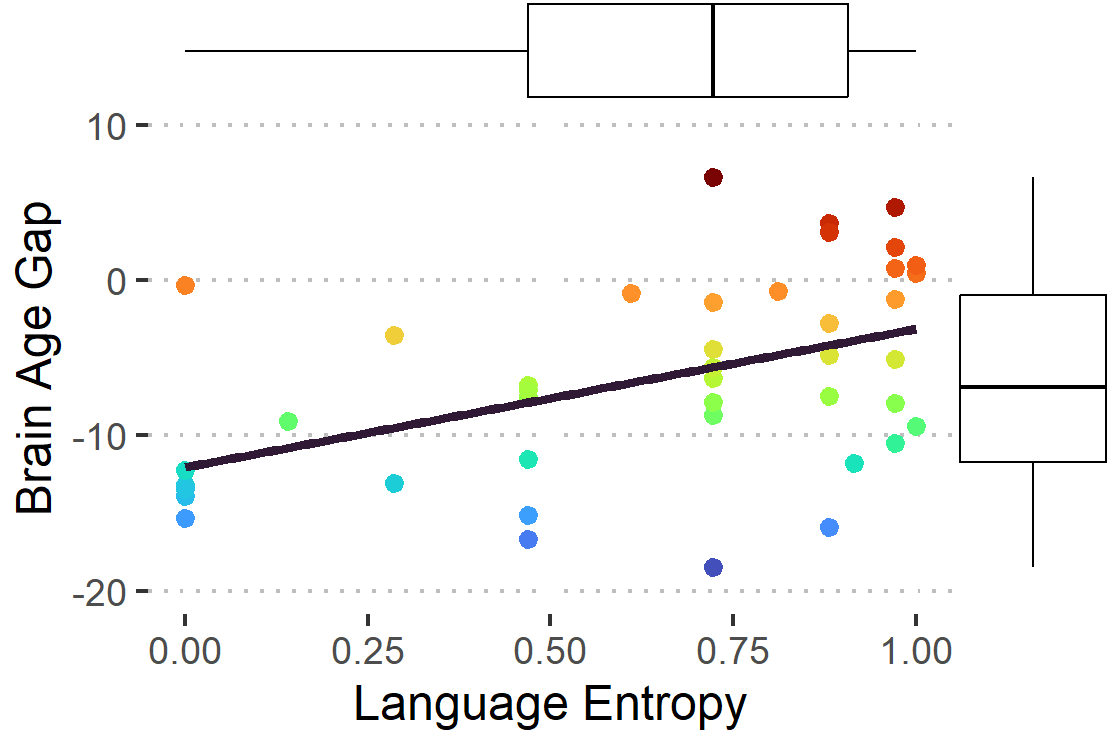
Fisher Z tests confirmed these patterns:
| Predictor × BAG | r | Z | p | Significant? |
|---|---|---|---|---|
| Language Entropy | 0.4365 | 2.996 | .003 | Yes * |
| L2 Fluency | 0.2212 | 1.440 | .150 | No |
| L2 Age of Acquisition | 0.0195 | 0.125 | .900 | No |
Full Regression Model
In the regression model controlling for age and all three bilingualism-related variables, language entropy remained a significant predictor of BAG (B = 11.47, p = .011):
| Predictor | B | SE | t | p |
|---|---|---|---|---|
| (Intercept) | −1.586 | 16.550 | −0.096 | .924 |
| Age | −0.092 | 0.208 | −0.442 | .661 |
| L2 Fluency | −1.023 | 1.177 | −0.869 | .390 |
| L2 Age of Acquisition | −0.028 | 0.150 | −0.186 | .853 |
| Language Entropy | 11.471 | 4.305 | 2.665 | .011 * |
R² = .209, Adj. R² = .128 · F(4, 39) = 2.577, p = .052 · Residual SE = 6.531
Simplified Model — Covariate Check (buildmer)
A covariate check was run via buildmer on the clean dataset with outliers removed. Language entropy remained significant. The model retained only age and entropy as predictors:
| Predictor | B | SE | t | p |
|---|---|---|---|---|
| (Intercept) | −6.917 | 14.971 | −0.462 | .647 |
| Age | −0.081 | 0.204 | −0.396 | .694 |
| Language Entropy | 8.835 | 3.007 | 2.938 | .005 ** |
R² = .194, Adj. R² = .154 · F(2, 41) = 4.922, p = .012 · Residual SE = 6.432
Conclusion
Greater global language entropy, that is, a more balanced overall distribution of language use across one's total conversations, was associated with an increased BAG, meaning a brain that appears older than its chronological age. This finding ran contrary to our initial expectations, given the hypothesized protective role of bilingualism on brain aging.
Although the small sample size warrants caution, these preliminary findings highlight the importance of considering multiple facets of bilingualism together, along with the interindividual factors that may interact with them. Incorporating cognitive, EEG, and more complex language measures in the future may help clarify how bilingualism relates to brain aging and cognitive reserve.
References
- Tablante J, Casaletto K, VandeVrede L, et al. The role of bilingualism on functional decline and neurodegeneration in distinct ADRD clinical syndromes. Alzheimer’s & Dementia. 2025;21:e70991. doi:10.1002/alz.70991
- Cole JH, Franke K. Predicting age using neuroimaging: innovative brain ageing biomarkers. Trends in Neurosciences. 2017;40(12):681–690. doi:10.1016/j.tins.2017.10.001
- Shannon CE. A mathematical theory of communication. Bell System Technical Journal. 1948;27:379–423. doi:10.1002/j.1538-7305.1948.tb01338.x
Acknowledgments
This project is funded by a grant from the Alzheimer Society of Canada to Shanna Kousaie. We thank Patrice Yazdanyar, Emma Moores, Madeline Smith, and the CNB Lab members for their assistance with participant recruitment and data collection. We gratefully recognize the contribution of all participants.